Able to distill light and shadow, pre-camera, they came, they saw, they drew. The Gray Collection: Seven Centuries of Art, Art Institute of Chicago, is a must-see exhibition of masterworks for serious artists and especially valuable for watercolorists and any artist who loves to make work on paper. The exhibit began September 25 and runs through January 2, 2011.
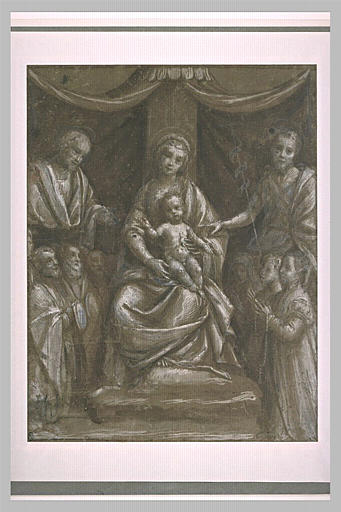
When you first walk into the exhibition, a large-scale ink drawing on paper by Bernardino Lanino comprised of six sheets joined together hits you. It is Mother and Child, Warrior Saint and Group of Worshippers, 1563/70. The drawing is tender and magnificent; the touch of the pencil delicate, making it clear Bernardino studied Leonardo DaVinci carefully. Brown, black, and white ink on blue-green paper give this a mystical feel.
First corridor to the left: you should look for the Ubaldo Gandolfini’s Flagellation of Christ, a sepia pen and wash drawing, from the early 1700’s. The red chalk and evidence of scale precision make this worth studying. There is a powerful, tender, youthful, Guercino of St. John the Baptist seated by a spring, 1652. The extravagant and original Salvador Rosa is represented by free, abstract brushwork to animate the subject by raising of Lazarus. It is early 1600’s, pen and iron-gall ink with a red chalk under-drawing. Canaletto Riva Degli Schrivon’s, Venice by St. Marks Sq, 1755, is seen from the market at the Pier. Pen and iron-gall ink contrast with the beautiful gray wash, reminiscent of the English method. Anyone who loves Venice will note the two famous columns of St. Theodore seen up close and St. Marks’ winged Lion on right and Palazzo Ducale squarely on the left. In a time before contemporary tourists, St. Marks is seen alive with Venetians at work. A delicate Guradi Lagoon and his study of 1780’s view of San Campo Zampolo, both scenes of Venice, balance light and shade. They are drawn impeccably and there is no need for strong contrast.
A fascinating work of Tiepolo, Democritus and Heraclitus Laughing and Sorrowing over the Follies of the World, 1742/43, commands much thought. Tiepolo made a large number of drawings, besides paintings and frescos for which he is famous. This work on paper, considered one of Tiepolo’s most monumental and enigmatic pen and ink composition - with Democritus holding his compass and globe in a world that is resting in the dry Earth. An animal and human skull litter the earth. A serpent coils on a staff; Heraclitus leans over Democritus’ shoulder to participate on the evaluation of the world’s folly.
In the Gray Collection, the 19th century is superbly represented as well: Gericault, David. Ingres, Cezanne, Daumier, Delacroix, Degas, De Chavannes and Seurat give anyone an art history lesson.
I was especially taken by a remarkable Odilon Redon, a black charcoal and chalk drawing Primitive Being, 1867. This drawing features the David and Goliath theme with a naked 'primative being' contemplating the enormous decapitated head of a giant on the ground. This was part of Redon’s ‘noir’ series of mid 1880’s. We all think of Seurat and his Sunday Afternoon masterpiece painting. Don’t overlook his stunning landscape revealing his segmented synthesis of form and tone. Vuillard’s In the Salon 1899/1903 used longer, structured brushwork than other of Vuillard’s interiors. Featured is a gem of a Cezanne, his small portrait of Madame Cezanne, 1833/85.
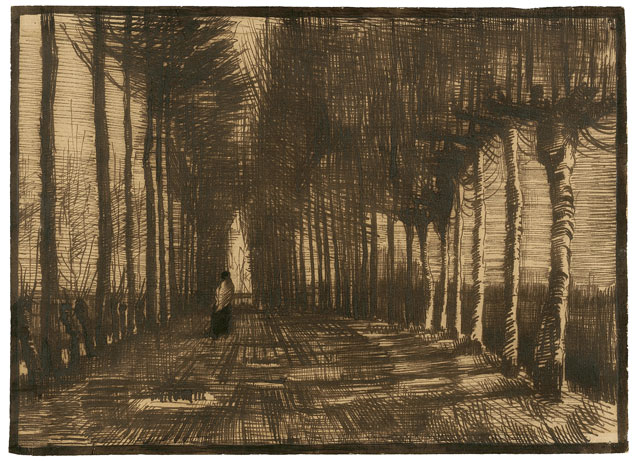
A beautiful Van Gogh landscape is his Avenue of Pollard Birches and Poplars, March 1884. This masterful ink drawing was inspired by the poem Tristement (Sadly) by François Coppie, describing a mourning widow. Here she walks away for us between tall narrow plane trees. Van Gogh used reed pen with his signature stunning intensity of pen-work using iron gall ink on tan laid paper. Ingres' work is stunning in any media, so enjoy a pen and ink wash drawing, Borghese Chapel, 1824 or a careful line portrait of Countess de Castellane 1834. Be surprised by occasional sculptures in the Gray Collection: Rodin’s bronze St. John the Baptist Preaching, 1878, rounds out the 19th century room.
Next, the 20th century: first, an abstract and delicate Hans Arp bronze, Mediterranean Group 1941-42. Giacometti’s oil portrait of G. David Thompson, shows a touch of tenderness in the face, was created in 1955. Thompson was a Pittsburg industrialist who was Giacometti’s largest collector at the time.There are other 20th century titans: Le Corbusier, Klee, Matisse, Rodchenko, Leger, Kandinsky, Schwitters, and Gris. A huge delightfully muted Miro collage of tan and brown paper with black conte and touches of white gouache and pen shows his relaxed confidence. Miro makes buoyant cut forms, and linear astronomical elements in black ink. In my opinion, the show also contains a rare Miro work on paper with ink/ wash, collage, watercolor, black chalk and transfer decals of butterflies, a moth, humming bird. The recognizable shapes of grapes, cherries, and lime decals were handled in the same superior compositional bravura as his free-form and lines caprices.
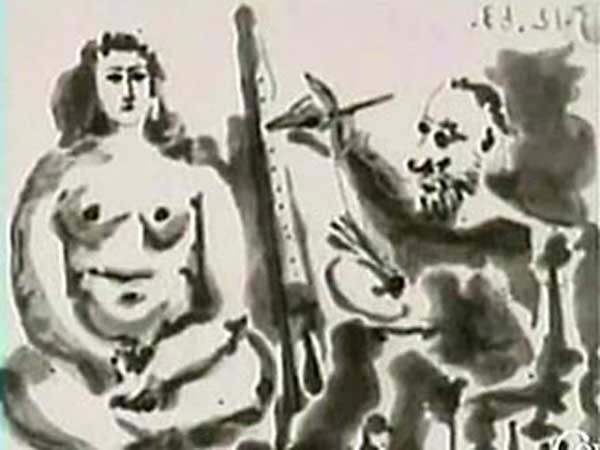
There is a fabulous Picasso 1933 Artist and Model watercolor and pen and black ink. It is commanding, having no traces of under-drawing. All Picasso’s works are exquisite and represent variations periods of his oeuvre. His colleague Juan Gris is represented by La Carte- Lettre, 1921, a beautifully-fragmented still life that shows the power of combination dry and wet media: a careful graphite drawing has several delicate black ink lines and the lampshade in solid black ink. Gris is seeing color in monochrome. In the final area of the exhibition loom three large Jim Dine portraits, one of his characteristic mixed media drawings, including dry media, acrylic, spray paint collage and abrading. This man can pick up any material, combined in unexpected ways and make commanding work.
20th century Brits are represented by two David Hockey works on paper and Lucien Freud's small oil, Annie and Alice, 1973, his first double female portrait. It features his eldest daughter, Annie who is pregnant with her first child. Americans of course are well-represented. Roy Lichtenstein, he gets more bang out of graphite and colored pencil than anyone I know. There is wonderful figure work by Alex Katz, Cornell, Diebenkorn and De Kooning. In spite of the pull of abstraction in the 20th century, figure works retain their power. There is a pulsing, abstract Sam Francis watercolor with gouache, in his early signature drip and pull style, called Black and Green, 1935. Delightful to see is the provocative George Segal Still life assemblage that is homage to the cubist Braque: Still Life w /Pipe, Chair, and Apples (Braque.) This piece is deelply instruction, showing the interplay of art historic awareness with contemporary trends that Segal was 'trying out' in the radical 1960's. Keep smiling; there is an Oldenburg Typewriter Eraser and his crayon and watercolor study for the sculpture. The Art Institute prepared a a fully illustrated catalogue available in the Museum Shop or online at www.artinstituteshop.org